
License plate fonts: what each country and state uses
Which lettering goes on a license plate in Germany, the UK, the US states, Brazil and more, what the law actually says about it, and where you can get each font legally.
The short answer: there is no single license plate font. Each country, and in the US each state, decides its own lettering. A few names cover most of what people mean:
- Germany: FE-Schrift, a typeface designed to be hard to forge.
- United Kingdom: the "prescribed font" drawn in the 2001 regulations, which plate makers call Charles Wright.
- Brazil and Argentina (the Mercosur plate): FE-Engschrift, the narrow cut of FE-Schrift.
- Greece: DIN 1451, the German road-sign typeface.
- United States: no national font. Each state makes its own plates, and none of the statutes we've read names a typeface.
Something most font sites don't tell you: in most countries the law doesn't name a font at all. It draws the letters, in an annex or a schedule, and the plate must match that drawing. That's why "where to download the official license plate font" usually has no answer, and why the fonts you'll find online are replicas. Below is what each country's own law says, with a link to it, and which replicas you can license.


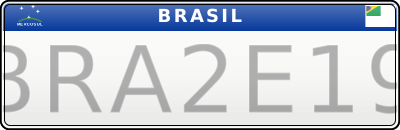
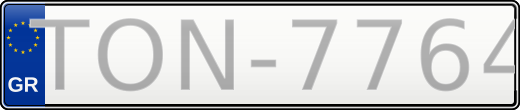
These are our own drawings of each country's current plate, to show where the characters sit and how big they are. They're not a font file; for the exact letterforms, use the sources in the table further down.
The UK number plate font (Charles Wright)
UK law doesn't use the name Charles Wright anywhere. The Road Vehicles (Display of Registration Marks) Regulations 2001 define a "prescribed font", and Schedule 4 is a drawing of every character in it: one set at 79 mm tall for cars, and a separate set at 64 mm for motorcycles.
What regulation 15 says, in plain words:
- A plate on a vehicle first registered on or after September 1, 2001, or any replacement plate fitted from that date, must use the prescribed font. The one exception is a vehicle first registered before January 1, 1973.
- Older plates may use the prescribed font or a style "substantially similar" to it.
- Either way, these are out: italic letters, slanted characters, strokes that curve or line up very differently from the prescribed font, double or broken strokes, and any character shaped to look like another one. Serifs on their own don't make a font illegal.
On a car plate, the characters are 79 mm tall and 50 mm wide (except the 1 and the I), with a 14 mm stroke; on a motorcycle they're 64 mm tall and 44 mm wide, as the British Number Plate Manufacturers Association summarises it. The BNMA also says it plainly: "The legal number plate font is Charles Wright", which is the trade name for that drawing. Our UK plates page has the formats and sizes.
The German license plate font (FE-Schrift)
German plates use FE-Schrift, short for fälschungserschwerende Schrift, "the font that makes forgery harder". The German National Library records that it was developed in 1978 to 1980 by Karlgeorg Hoefer for the Federal Highway Research Institute (BASt), designed to be "difficult to forge and easily machine-readable", has been on German plates since 1994, and completely replaced DIN 1451 in 2000 after a transition (DNB).
The law behind it is Annex 4 of the Fahrzeug-Zulassungsverordnung: the lettering must match the official samples called "Schrift für Kfz-Kennzeichen", which you get from the BASt. Characters are 75 mm tall in both the normal (Mittelschrift) and narrow (Engschrift) cuts, and 49 mm on motorcycle and small two-line plates. Bundeswehr plates and moped insurance plates are the exception: they still use DIN 1451.
The same typeface travels: Brazil and Argentina name FE-Engschrift for the Mercosur plate, and South Africa's Free State provincial notices call for "FE modified 75mm" per the SABS 1116 standard. More on those below. Our Germany page has every German plate type, and /kennzeichen decodes every district code.
The Italian license plate font
Italian law doesn't name a typeface either. Article 260 of the Highway Code regulation says the size of the plates and the shape of their characters are "those shown in the figures annexed" to it, and the models are deposited with the transport ministry (DPR 495/1992). So the official Italian plate font is, again, a drawing.

If you want that look in a design, the licensed option is Targa by Zetafonts: Luc Devroye's archive records that Cosimo Lorenzo Pancini drew it in 2002 from "the peculiar sans serif monospace typeface" Italy uses on its plates, and Francesco Canovaro redrew it as the multi-weight Targa Pro in 2022 (Luc Devroye). It's inspired by the plates, not the plate drawing itself. Our Italy page has the formats.
US license plate fonts: every state has its own
There's no national US license plate font. The closest thing to a rule is the AAMVA License Plate Standard (Edition 2), a standard the states can adopt rather than a law. It doesn't name a typeface either. It asks for:
- characters at least 2.5 inches tall, spaced at least 0.25 inches apart, with a stroke between 0.2 and 0.4 inches;
- "standardized fonts and font sizes that clearly distinguish characters", so that A and R, 8 and B, or O and Q can't be mixed up.
Each state then picks its own lettering, and the statutes we've read leave it to the motor vehicle department. Texas puts it in so many words: "The department has sole control over the design, typeface, color, and alphanumeric pattern for all license plates" (Tex. Transp. Code § 504.005(a)).
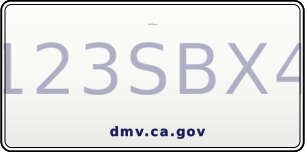
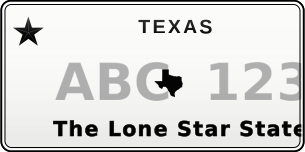
California license plate font
California doesn't publish a named typeface for its plates. They're made by incarcerated workers at Folsom State Prison, which has manufactured California's license plates since 1947, today from aluminium with reflective sheeting (CALCTRA). The font designers usually reach for is Penitentiary Gothic by Andrew Leman and Richard Lucas (2001), a commercial font that Ward Nicholson's survey of plate fonts describes as a "replica of California's font" (Luc Devroye's type archive). The red "California" script at the top is a separate piece of lettering, not part of any plate font. See California license plates for the current 1ABC123 and new 123ABC1 formats.
Other states
The same survey lists replicas for other states: License Plate by Dave Hansen (2005, free) after Washington's lettering, and Pennsylvania by Christian Schwartz (2000, commercial) and Keystone State by Anuthin Wongsunkakon (1999, commercial) after Pennsylvania's. It also notes that 3M based the default fonts of the digital plate system it sold to US prison plate shops on Bitstream's Zurich Extra Condensed, a close relative of Univers. None of these is an official state font; they're the closest licensed matches. For any other state, the safe route is its DMV.
What each country's law says about the letters
This is what our plates dataset records for each jurisdiction, from the regulation itself. "Drawn in the law" means the regulation includes a picture of each character rather than naming a typeface.
| Jurisdiction | What the law prescribes | Source |
|---|---|---|
| Germany | FE-Schrift samples from the BASt; 75 mm (49 mm on motorcycles); DIN 1451 on Bundeswehr plates | FZV Annex 4 |
| United Kingdom | The prescribed font, drawn in Schedule 4; 79 mm, 64 mm on motorcycles; mandatory since September 2001 | S.I. 2001/561 reg. 15 |
| Brazil | FE-Engschrift, 65 mm (53 mm on motorcycles); "BRASIL" in Gill Sans | CONTRAN Res. 969/2022, Annex I |
| Argentina | FE-Engschrift, 65 mm (53 mm on motorcycles) on the Mercosur plate | Ley 27.187, Annex |
| Greece | DIN 1451: the narrow cut for letters, the medium cut for digits | ΥΑ 4700/330/2004 art. 2 |
| South Africa | "FE modified 75mm" per SABS 1116 (Free State notices; other provinces not established) | Free State PN 51 of 2002 |
| France | No named font: plain sans serif "caractères bâtons", no narrowing, no serifs, gaps in closed letters no wider than 3 mm | Arrêté of February 9, 2009, art. 6 |
| Austria | No named font: samples held by the ministry; 10 mm stroke, 71 to 72 mm tall, a width for every character | KDV Annex 5e |
| Czechia | No named font: 75 mm tall, 40 mm wide, 10 mm stroke on the long plate; embossed | Vyhláška 243/2001 § 24 |
| Italy | No named font: characters as drawn in the figures annexed to the regulation | DPR 495/1992 art. 260 |
| Poland | No named font: a dimensioned drawing of every letter and digit (Figure 7) | Dz.U. 2024 poz. 1709, Annex 12 |
| Belgium | No named font: characters drawn in Annexes 1 and 2 | Arrêté ministériel of 2001 |
| Finland | No named font: dimensioned drawings at 72, 70, 56 and 35 mm; transfer plates in Arial Narrow Bold | Traficom regulation § 4.2 and § 5 |
| Estonia | No named font: four drawn letter types, 49 or 77 mm | Regulation 49, Annex 2 |
| Switzerland | No named font: the federal roads office (ASTRA) decides the lettering | VZV art. 85(5) |
| Monaco | Swiss721 BT, named for the provisional WW plates | Arrêté ministériel 78-5 |
| Japan | No named font: characters as drawn in Form No. 1 of the road vehicle rules | Road Transport Vehicle Act rules, art. 11 |
| Mexico | No named font: characters drawn in figures 36 to 39 of NOM-001-SCT-2-2016 | DOF, June 24, 2016 |
| India | No named font: sizes only, 65 mm tall with a 10 mm stroke for cars | CMVR rule 51 |
| Texas | No named font: the Texas DMV has "sole control over the design, typeface" | Transp. Code § 504.005(a) |
| United States (other states) | No national font; AAMVA recommends 2.5 in characters that can't be confused | AAMVA standard § 2.2, 2.3 |
A few more findings from the same research. Sweden and Denmark don't prescribe any lettering at all, and neither does New Zealand. Cyprus and Malta are often said to require FE-Schrift; Cyprus draws its letters in a 2013 notice without naming any typeface, and Maltese law names none and draws none. Slovenia's lettering is usually called Helvetica, but the regulation only points to a technical specification that isn't published. Sources as of November 11, 2026; laws change, so check the link before you rely on a row.
Where to get a license plate font legally
Because the official letters are mostly drawings, "legally" means one of three things:
- Read the drawing in the law. The UK's Schedule 4, Poland's Figure 7, Finland's annexes and Japan's Form No. 1 are published with the regulation itself. That's the reference for checking a design, not a ready-to-type font.
- Ask the authority. Germany's annex says the FE-Schrift samples come from the Bundesanstalt für Straßenwesen, so that's the official source; we haven't found a public licence for any digital FE-Schrift file, so check the terms of whoever sells you one.
- License a replica from its foundry. Penitentiary Gothic (California) and Pennsylvania are commercial; K-Type's Mandatory is "developed from the typeface used for UK vehicle registration plates" and is free for personal use, with paid licences for commercial work. Where a law names a commercial typeface (Gill Sans in Brazil, Swiss721 in Monaco, Arial Narrow in Finland), it comes from that typeface's foundry like any other font.
A replica is fine for a mock-up, a poster or a game. It doesn't make a plate road-legal on its own; the plate itself still has to come the way your registration authority says.
Plates in your own product
If you need license plates in an app (a parking tool, a car listing, a fleet dashboard), you don't need a font at all. Every license plate page on VehiclesDB draws the real design for that country or state, with any registration number, and the same plate images are available through the API next to the plate formats, sizes and validation rules for every jurisdiction we cover.
Questions people ask
What font is used on license plates?
It depends on who issues the plate. Germany uses FE-Schrift, the UK uses the font drawn in Schedule 4 of its 2001 number plate regulations (sold commercially as Charles Wright), Brazil and Argentina use FE-Engschrift, and Greece uses DIN 1451. Most US states set their own lettering and publish no named typeface; the AAMVA standard only asks that characters are at least 2.5 inches tall and easy to tell apart.
What font does California use on its license plates?
California's DMV does not publish a named typeface. The plates are made at Folsom State Prison, as they have been since 1947. The commercial font Penitentiary Gothic (Andrew Leman and Richard Lucas, 2001) is a replica of California's plate lettering, so it is the closest licensed match for a design.
What is the UK number plate font called?
The law calls it the prescribed font: a drawing in Schedule 4 of the Road Vehicles (Display of Registration Marks) Regulations 2001, at 79 mm for cars and 64 mm for motorcycles. The name Charles Wright is the trade name plate makers use for it; it does not appear in the regulations. Plates fitted from September 1, 2001 must use it.
Is there a free license plate font?
Some replica fonts are free for personal use, such as K-Type's Mandatory, which is developed from the UK plate lettering and needs a paid licence for commercial work. The official letterforms themselves are usually drawings published in the law (UK, Poland, Finland, Japan) or supplied by an authority (Germany's BASt), not font files.
Can I put any font on my license plate?
Not in most places. In the UK, under regulation 15 the prescribed font is mandatory on plates fitted from September 2001 and bans italic, slanted, broken or look-alike characters. In Germany the lettering must match the official FE-Schrift samples. In Texas the state DMV has sole control over the typeface. Check with your DMV or registration authority before you order a plate.