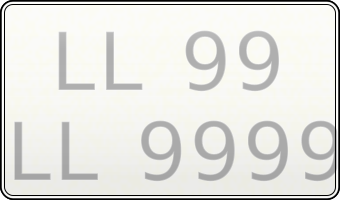
India license plate: Standard
Retired 1989 to 2003. Standard plates for car, van, motorcycle, tractor, and machine, issued by Ministry of Road Transport and Highways (MoRTH), Government of India. One of 16 India license plates.
Format, years and the law
- Format
-
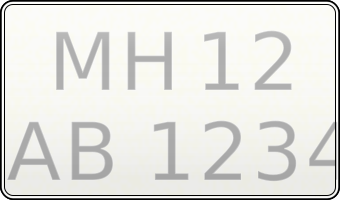
LL 99 LL 9999, for exampleMH 12 AB 1234(L is any letter, 9 any digit)Left to right: two letters for the State or territory (MH is Maharashtra, DL is Delhi), one or two digits for the registering office within it, then a series and a four-digit number. The office codes are each State's own invention, over a thousand, never centrally listed.
The format above follows the issuing rules: a registration that fits it is one this series could have issued.
- Years issued
- 1989 to 2003. No longer issued.
- Vehicle class
- Standard: the default series issued to private road vehicles. Issued for car, van, motorcycle, tractor, and machine.
- Colours
-
Characters
#000000Background#FFFFFF - Size
-
340 × 200 mm · every country's size
-

Standard 500×120 mm
standard · 500 × 120 mm
-
Standard 200×100 mm
standard · 200 × 100 mm
-

Standard 285×45 mm
standard · 285 × 45 mm
-
- About this plate
- In fact non-HSRP plates went on being made in most States for another fifteen years, until the HSRP Order 2018 put the obligation on vehicle manufacturers from 1 April 2019.
- How the region is encoded
- TWO GEOGRAPHIC ELEMENTS, ONE CLOSED AND ONE OPEN, AND A PARSE API MUST NOT TREAT THEM ALIKE. (1) The first two letters are the STATE/UT code, a closed list allotted by the Central Government under MVA § 41(6), the decode table. (2) The two digits are the REGISTERING AUTHORITY (RTO DISTRICT) code, which no central instrument enumerates: rule 50(3) simply calls it "registering authority code" and rule 35(3) calls it "RTO Code". A decode may return the State with confidence and the district only against a State-published list of that State's own offices, dated. THIRD ELEMENT, FLAGGED AS UNSOURCED: several States are widely reported to spend the first letter of the series group on a VEHICLE-CLASS code rather than on the series, Delhi's "C" for car in "DL 3C AB 1234" is the famous case. A parse API must not decode a class from it.
- How numbers are issued
- The series group advances within a district as its four-digit block exhausts (single letter, then two, then three); the allocation order is an administrative matter for each State's registering authority and is published by none of them uniformly. A series letter therefore gives a LOWER bound on age within a district and nothing stronger.
Legal basis and sources
- web.archive.org https://web.archive.org/web/20250804185944id_/https://www.indiacode.nic.in/bitstream/123456789/1798/1/aA1988-59.pdf
- web.archive.org https://web.archive.org/web/20211130113450id_/https://morth.nic.in/sites/default/files/CMVR-chapter3.pdf
- web.archive.org https://web.archive.org/web/20210514201915id_/https://morth.nic.in/sites/default/files/notifications_document/S.O.%20...
Before and after
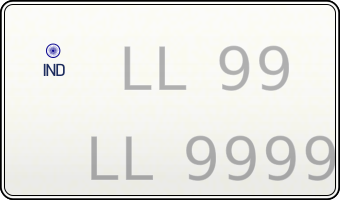

This plate in your app
The series id is in-standard-1989. The API returns its format, validation, colours and designs with the rest of India's series:
curl -s https://vehiclesdb.com/api/v1/plates/in \
  -H "Authorization: Bearer $VEHICLESDB_API_KEY" \
  | jq '.series[] | select(.id == "in-standard-1989")'
- Plate image (SVG, sample serial): https://vehiclesdb.com/plates/in/in-standard-1989.svg
- Blank template, filled on your side: https://vehiclesdb.com/plates/in/in-standard-1989/template.svg