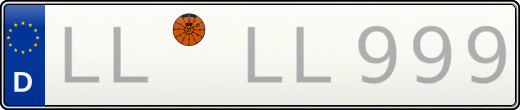
Germany license plate: Standard
Issued today 1995 to today. Standard plates for car, van, truck, bus, motorcycle, and trailer, set by the Fahrzeug-Zulassungsverordnung (FZV). One of 13 Germany license plates.
The German standard: district code, registration seals, and FE-Schrift, the plate as a tamper-evident document.


Format, years and the law
- Format
-
LL-LL 9999, for exampleM KA 2843(L is any letter, 9 any digit)The one-to-three-letter prefix names the registration district, and roughly speaking the bigger the place, the shorter the code: B is Berlin, M München, GAP Garmisch-Partenkirchen. Everything after the seal is a meaningless serial, a German plate tells you where, never when.
The format above follows the issuing rules: a registration that fits it is one this series could have issued.
- Years issued
- 1995 to today. Still issued.
- Vehicle class
- Standard: the default series issued to private road vehicles. Issued for car, van, truck, bus, motorcycle, and trailer.
- Colours
-
Characters
#000000Background#FFFFFF - Size
-
520 × 110 mm · every country's size
-
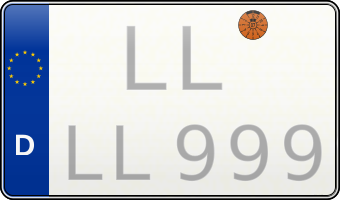
Standard 340×200 mm
standard · 340 × 200 mm
-
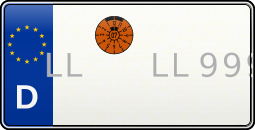
Standard 255×130 mm
standard · 255 × 130 mm
-
- About this plate
- No age is encoded on a German plate at all, unlike the UK, a German plate string carries region but never date.
- How the region is encoded
- The Unterscheidungszeichen is 1-3 letters identifying the Verwaltungsbezirk of registration (§ 9 Abs. 1 Nr. 1). The list is set by the BMDV on application by the Länder and published in the BUNDESANZEIGER (§ 9 Abs. 3), NOT in the FZV and NOT by the KBA. A district may hold more than one code, applied for when "ohne dieses ein Verbrauch der verfügbaren Kennzeichenkombinationen unmittelbar bevorsteht". A withdrawn code may be carried until the vehicle is deregistered, so decode rows close by period and are never deleted. The split point between prefix and Erkennungsnummer is UNAMBIGUOUS because Anlage 1 fixes the Erkennungsnummer to 1-2 letters + 1-4 digits.
- How numbers are issued
- Anlage 1 Nr. 2 allocates the Erkennungsnummer in five blocks: a) 1 letter + 1-999, b) 2 letters + 1-99, c) 2 letters + 100-999, d) 1 letter + 1000-9999, e) 2 letters + 1000-9999.
- Separators
- The gap between Unterscheidungszeichen and Erkennungsnummer is physically occupied by the two Plaketten (Stempelplakette + HU badge), not by a printed separator.
Legal basis and sources
- § 9 Abs. 1: Kennzeichen = Unterscheidungszeichen (1-3 letters for the Verwaltungsbezirk) + vehicle-specific Erkennungsnummer allocated per Anlage 1; Abs. 3: BMDV/Bundesanzeiger https://www.gesetze-im-internet.de/fzv_2023/__9.html
- Anlage 1: the five Erkennungsnummer shapes and the umlaut exclusion, verbatim https://www.gesetze-im-internet.de/fzv_2023/anlage_1.html
- § 12 Abs. 1: black on white, black-bordered; Abs. 2: reflective + DIN 74069; Abs. 5: front/rear rules https://www.gesetze-im-internet.de/fzv_2023/__12.html
- Anlage 4 Abschnitt 1: dimensions, FE-Schrift, Euro-Feld, the eight-position cap; Abschnitt 2: the general plates https://www.gesetze-im-internet.de/fzv_2023/anlage_4.html
- 21. ÄndVstVR vom 6.1.1995, BGBl. I S. 8, § 60 Abs. 1b StVZO + Anlage Va 'Muster und Maße der Euro-Kennzeichen'; 'Diese Verordnung tritt am 15. Januar 1995 in Kraft.' PERIOD START. https://media.offenegesetze.de/bgbl1/1995/bgbl1_1995_1.pdf
- 32. ÄndVStVR vom 20.7.2000, BGBl. I S. 1090, Euro plate mandatory for newly fitted plates from 1.11.2000; pre-existing plates 'gelten weiter'. https://media.offenegesetze.de/bgbl1/2000/bgbl1_2000_34.pdf
This plate in your app
The series id is de-standard. The API returns its format, validation, colours and designs with the rest of Germany's series:
curl -s https://vehiclesdb.com/api/v1/plates/de \
  -H "Authorization: Bearer $VEHICLESDB_API_KEY" \
  | jq '.series[] | select(.id == "de-standard")'
- Plate image (SVG, sample serial): https://vehiclesdb.com/plates/de/de-standard.svg
- Blank template, filled on your side: https://vehiclesdb.com/plates/de/de-standard/template.svg