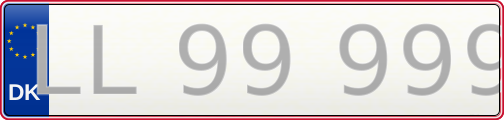
Denmark license plate: Standard
Issued today 1976 to today. Standard plates for car, issued by Skatteforvaltningen (Motorstyrelsen). One of 21 Denmark license plates.

Format, years and the law
- Format
-
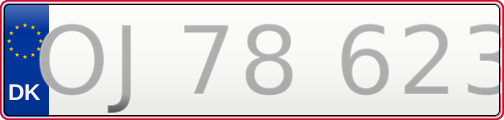
LL 99 999, for exampleOJ 78 623(L is any letter, 9 any digit)The format above follows the issuing rules: a registration that fits it is one this series could have issued.
- Years issued
- 1976 to today. Still issued.
- Vehicle class
- Standard: the default series issued to private road vehicles. Issued for car.
- Colours
-
Characters
#000000Background#FFFFFF - Size
-
504 × 120 mm · every country's size
-
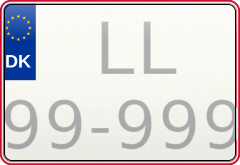
Standard 240×165 mm
standard · 240 × 165 mm
-
- About this plate
- THE DANISH STANDARD PLATE. Two things about it are unusual and both are sourced. First, the SIZE: 504 x 120 mm, not the 520 x 110 mm that the rest of Europe uses and that both Wikipedia infoboxes assert, SKAT's own catalogue says "120x504" in every white-plate row, and the archived skat.dk series page says "120 x 504" for Serie 61. The 520 x 110 figure is corrected away here. Second, the EU BAND IS OPTIONAL and has been since it appeared: § 68, stk. 5 gives the choice to whoever registers the vehicle, so a bandless Danish plate may be brand new. Colour is white ground / black characters / red border throughout; the red border is what makes the plate recognisable and it appears in no instrument.
- About its years
- 1976 is 1 APRIL 1976, and it is dated by the instrument in force today rather than by an enthusiast page: BEK 663/2025 § 72, stk. 4, nr. 4 refuses a replacement plate where the number does not follow "de retningslinjer for udformning af registreringsnumre, der har været gældende siden den 1. april 1976"; § 70, stk. 3 exempts "nummerplader fra før den 1. april 1976" from the two-screw rule; § 75, stk. 1 opens the historic plate to vehicles "registreret første gang før den 1. april 1976".
- Region code notes
- NOT geography, Denmark encodes VEHICLE KIND in the digit block and has encoded no region since the single-letter county plates ended. The decode file is named for what it actually decodes.
- How numbers are issued
- NO AGE SIGNAL, NO GEOGRAPHY. The two letters are a serial, not a region: the pre-1958 single letter was the county marker and it is long gone. 6), and allocation restarted from AA when the digital register came in, so a letter pair dates nothing.
- Separators
- The printed gaps are gaps, not glyphs: no Danish instrument prescribes a separator character.
Legal basis and sources
- § 68, stk. 2 (two Latin letters + one to five Arabic numerals); § 69, stk. 1 (two plates); § 70 (mounting); § 72, stk. 4, nr. 4 and § 70, stk. 3 and § 75, stk. https://www.retsinformation.dk/eli/lta/2025/663/dan/xml
- SKAT 'Liste over alle pladetyper i Danmark pr. https://web.archive.org/web/20170917063422/https://www.skat.dk/getFiles.aspx?Id=e6c2c7e8-e7a7-4b5e-b15e-4b67e27d3f66&...
- web.archive.org https://web.archive.org/web/20110716080639/http://www.skat.dk/SKAT.aspx?oId=1826647
- da.wikipedia.org https://da.wikipedia.org/wiki/Nummerplade
This plate in your app
The series id is dk-standard-1976. The API returns its format, validation, colours and designs with the rest of Denmark's series:
curl -s https://vehiclesdb.com/api/v1/plates/dk \
  -H "Authorization: Bearer $VEHICLESDB_API_KEY" \
  | jq '.series[] | select(.id == "dk-standard-1976")'
- Plate image (SVG, sample serial): https://vehiclesdb.com/plates/dk/dk-standard-1976.svg
- Blank template, filled on your side: https://vehiclesdb.com/plates/dk/dk-standard-1976/template.svg