Spain license plate: National
Issued today Documented since 2000. Standard plates for car, van, truck, bus, and motorcycle, issued by Dirección General de Tráfico (DGT). One of 19 Spain license plates.

Format, years and the law
- Format
-
9999 LLL, for example6376 WVV(L is any letter, 9 any digit)The letters mean nothing, on purpose. The three-letter block is a consonant-only counter (vowels, Ñ and Q are excluded) so no word, initials or province can ever be read into a Spanish plate.
The format above follows the issuing rules: a registration that fits it is one this series could have issued.
- Years issued
- Documented since 2000; the format is likely older than the first year documented. Still issued.
- Vehicle class
- Standard: the default series issued to private road vehicles. Issued for car, van, truck, bus, and motorcycle.
- Colours
-
Characters
#000000Background#FFFFFF - Size
-
520 × 110 mm · every country's size
-
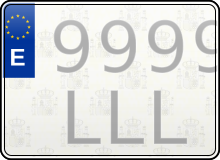
National motorcycle
motorcycle · 220 × 160 mm
-
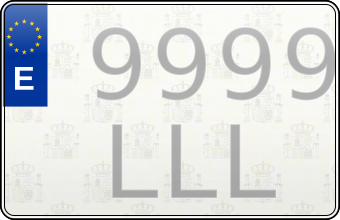
National 340×220 mm
standard · 340 × 220 mm
-

National 340×110 mm
standard · 340 × 110 mm
-
National 132×96 mm
standard · 132 × 96 mm
-
- About this plate
- THE CURRENT SPANISH SERIES. Purely sequential and non-geographic: the 2000 reform deliberately removed the province code. Anexo XVIII adds the reciprocal-recognition clause in terms: a Spanish car whose plate shows the EU flag and the E sign "no será necesario que lleven en su parte posterior el signo distintivo de la nacionalidad española previsto en la señal V-7". DIMENSION CORRECTION worth recording: the statute says 520 x 110 mm, not the 500 x 110 that circulates in secondary sources.
- How numbers are issued
- Digits cycle 0000-9999 within a fixed letter triple, then the letter triple advances one step in the 20-letter alphabet. Nationally sequential and MONOTONIC from BBB, which makes the letter triple an approximate-age signal and the ONLY decodable dimension of a post-2000 Spanish plate, there is no geography whatsoever in this series.
- Separators
- Anexo XVIII prescribes "dos grupos de caracteres" and gives the inter-group spacing in mm (Cuadro 1: 41 mm on the ordinaria larga) but prescribes no separator GLYPH. The space in the pattern is the printed gap.
Legal basis and sources
- Orden de 15-09-2000: replaces Anexo XVIII I.A.a) with '4 cifras + 3 letras' and adds the EU band; BOE's own Análisis block states 'Fecha de entrada en vigor: 17/09/2000' https://www.boe.es/buscar/doc.php?id=BOE-A-2000-16805
- canonical ELI for that Orden https://www.boe.es/eli/es/o/2000/09/15/(1)
- Anexo XVIII I.A.a) current wording: white retroreflective ground, black matte embossed characters, 4 digits 0000-9999 + 3 letters BBB->ZZZ minus vowels/Ñ/Q; Cuadro 1 dimensions; Cuadro 3 colour boxes https://www.boe.es/buscar/pdf/1999/BOE-A-1999-1826-consolidado.pdf
- Reg. 2411/98 Art. 3, the mutual-recognition rule the Orden's preamble invokes by name https://eur-lex.europa.eu/legal-content/EN/TXT/?uri=CELEX:31998R2411
Before and after
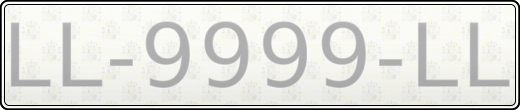

This plate in your app
The series id is es-national-2000. The API returns its format, validation, colours and designs with the rest of Spain's series:
curl -s https://vehiclesdb.com/api/v1/plates/es \
  -H "Authorization: Bearer $VEHICLESDB_API_KEY" \
  | jq '.series[] | select(.id == "es-national-2000")'
- Plate image (SVG, sample serial): https://vehiclesdb.com/plates/es/es-national-2000.svg
- Blank template, filled on your side: https://vehiclesdb.com/plates/es/es-national-2000/template.svg