
Ireland number plate: Standard 1991
Issued today Documented since 1991. Standard plates for car, van, truck, bus, and motorcycle, issued by Revenue Commissioners. One of 7 Ireland number plates.
Format, years and the law
- Format
-
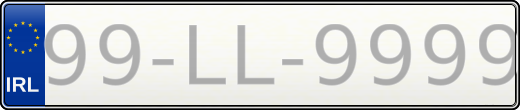
99-LL-9999(L is any letter, 9 any digit)The format above follows the issuing rules: a registration that fits it is one this series could have issued.
- Years issued
- Documented since 1991; the format is likely older than the first year documented. Still issued.
- Vehicle class
- Standard: the default series issued to private road vehicles. Issued for car, van, truck, bus, and motorcycle.
- Colours
-
Characters
#000000Background#FFFFFF - Size
-
520 × 110 mm · every country's size
-
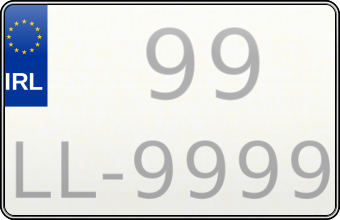
Standard 1991 340×220 mm
standard · 340 × 220 mm
-
- About this plate
- THE MODERN IRISH PLATE AS IT FIRST APPEARED, and an open-ended series that a naive reading would have closed in 2012. Two boundary facts are worth stating because both are routinely misdated. FIRST, the design boundary is 1 JANUARY 1991, not 1993: S.I. 287/1990 introduced the EU flag, the IRL sign, the Irish placename and the hyphen while vehicles were still registered by county councils under the Roads Act 1920, and the Revenue takeover on 1 January 1993 changed the registering authority and not one character of the plate. Modelling 1993 as a series start would record an administrative transfer as a design change. SECOND, this series has no end: S.I. 542/2012 did not close it, it CONFINED it to vehicles first brought into use on or before 31 December 2012, and those vehicles are still being imported and registered, so two-digit marks are still being issued in 2026. TRANSITION DETAIL: S.I. 287/1990 art. 3(c) also let 1987-1990 vehicles adopt the new plate voluntarily ("The provisions of this Part of this Schedule shall be deemed to be complied with if the identification mark exhibited on the vehicle complies with the provisions of Part III"), which is why an 88-D plate seen today usually carries the EU band it was never issued with.
- How numbers are issued
- sequential per index mark per YEAR (not per half-year, which arrives only in 2013); Reg. 9(3) permits the Commissioners to omit numbers from a sequence
Legal basis and sources
- S.I. No. 287 of 1990: art. 3(d) adds Third Schedule PART III, 'Provisions to be complied with in respect of vehicles registered on or after the 1st day of January, 1991', the EU flag, IRL, the Irish placename, the... https://www.irishstatutebook.ie/eli/1990/si/287/made/en/print
- S.I. No. 318 of 1992: Reg. 3 puts Reg. 9 into operation on 01-01-1993; Reg. 9(1) re-enacts the two-digit mark; the First Schedule re-enacts the Part III plate almost word for word. https://www.irishstatutebook.ie/eli/1992/si/318/made/en/print
- S.I. No. 542 of 2012 art. 4(a): confines Reg. 9(1) to a vehicle 'first brought into use on or before 31 December 2012 and' entered in the register, the provision that keeps this series ALIVE rather than closing it. https://www.irishstatutebook.ie/eli/2012/si/542/made/en/print
- Revenue's worked example: 'A car imported in 2017 that was first registered in the UK in 2011 will be registered as 11-xx-xxxx.' https://www.revenue.ie/en/vrt/vehicle-registration-tax/registration-plates-and-format-standards.aspx
Before and after


This plate in your app
The series id is ie-standard-1991. The API returns its format, validation, colours and designs with the rest of Ireland's series:
curl -s https://vehiclesdb.com/api/v1/plates/ie \
  -H "Authorization: Bearer $VEHICLESDB_API_KEY" \
  | jq '.series[] | select(.id == "ie-standard-1991")'
- Plate image (SVG, sample serial): https://vehiclesdb.com/plates/ie/ie-standard-1991.svg
- Blank template, filled on your side: https://vehiclesdb.com/plates/ie/ie-standard-1991/template.svg